Can your panel handle that EV charger, hot tub, or heat pump?

    Can My Panel Handle It? Check Before You Upgrade

    Free 60-second homeowner check — no electrician visit needed yet. Know before you pay $3,000–$5,000 for an upgrade you may not need.

    Skip the $3,000+ panel upgrade guesswork. Get an electrician-designed, NEC-inspired estimate before you call for quotes.

    Get clarity before you pay for quotes, upgrades, or a service call.

    No electrical knowledge required. Takes about 1 minute.

    Designed by a licensed electrician
    NEC-inspired methodology
    Built for homeowners before they call contractors

    $9.99

    vs $150–$300 service call

    ~60 sec

    average completion time

    NEC 220

    load method it's based on

    What can you check?

    Any high-load appliance you're thinking about adding. We'll estimate whether your panel has the headroom for it before you call a contractor.

    EV charger
    Hot tub
    Heat pump
    Induction stove
    Solar battery
    Tankless water heater
    Generator
    Pool equipment
    Mini-split
    Garage subpanel

    How It Works

    1

    Answer a few home & panel questions

    Panel size, square footage, and what upgrades you're planning.

    2

    See if your panel can likely handle the upgrade

    Get a fast result showing whether your home likely has enough electrical capacity or may need another solution.

    3

    Download your $9.99 report or share with your electrician

    Unlock a detailed load breakdown to bring to your next quote — typically saves a $150–$300 service call.

    Free photo review

    Have a licensed electrician review your panel photos

    Upload 4 simple photos. We'll send back an electrician-ready summary you can hand to any contractor — so you're not guessing what to ask.

    Photo 1
    Main breaker

    Close-up showing the amp rating stamped on the main breaker.

    Photo 2
    Panel label

    The manufacturer sticker inside the door listing make, model, and bus rating.

    Photo 3
    Full breaker layout

    A straight-on shot showing every breaker in the panel.

    Photo 4
    Planned install location

    Where you want the new EV charger, hot tub, heat pump, etc. to live.

    You receive an electrician-ready summary.

    Plain-English findings plus the technical notes a contractor will actually want to see.

    Why Panel Capacity Matters Today

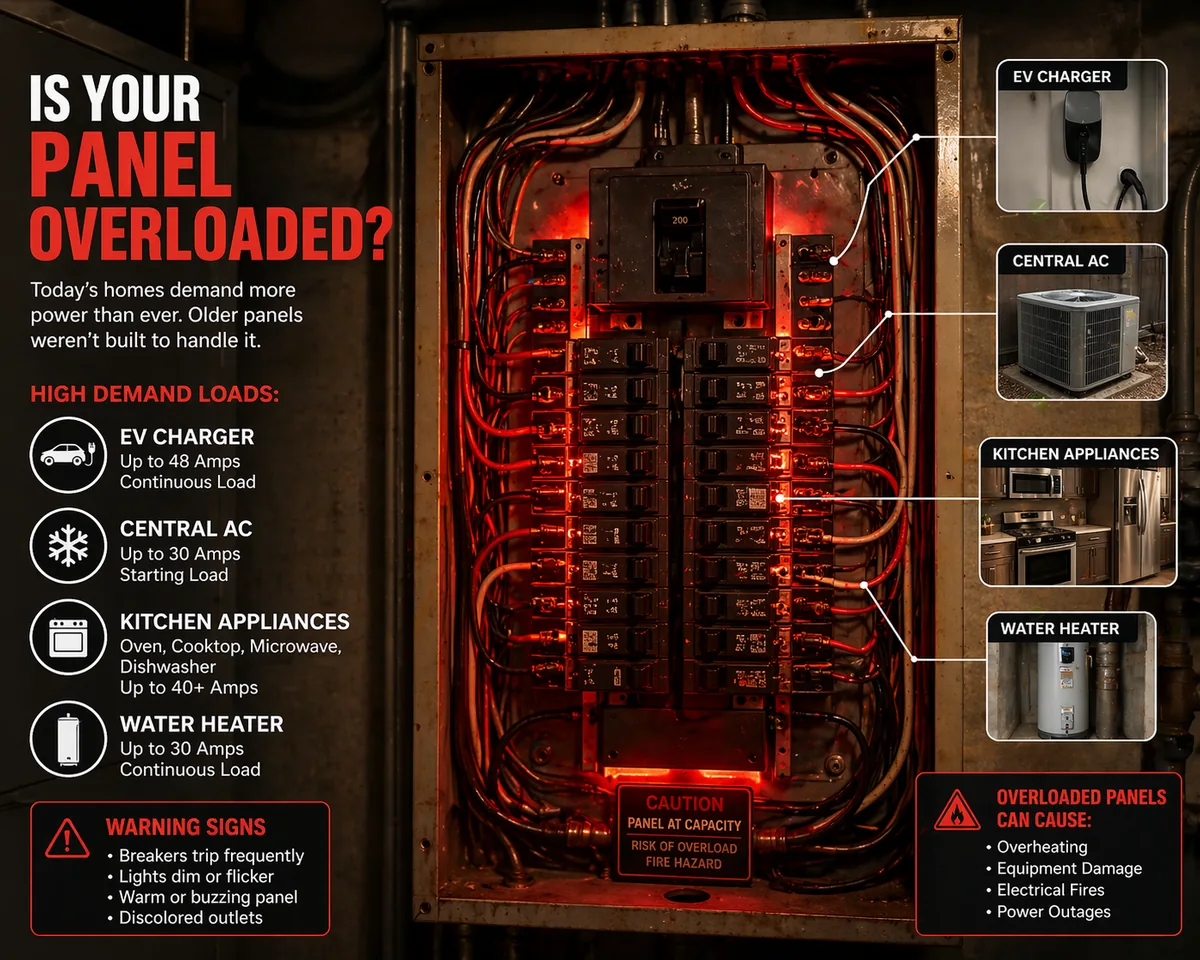
    Modern homes draw far more power than panels installed 20–40 years ago were designed for. Here's what's competing for capacity inside your panel.

    Infographic showing how EV chargers, central AC, kitchen appliances, and water heaters can overload an older electrical panel

    Panel Capacity & Overloaded Circuits: Common Questions

    How do I know if my electrical panel is overloaded?

    Common warning signs of an overloaded panel include breakers that trip frequently, lights that flicker or dim when large appliances start, warm or discolored breaker switches, and a faint buzzing sound from the panel. If you notice any of these, it's a sign your panel is being pushed close to its capacity.

    What uses the most electricity in a modern home?

    EV chargers, central air conditioning and heat pumps, electric water heaters, electric ranges and ovens, and clothes dryers are typically the largest loads. A single Level 2 EV charger alone can pull as much power as an entire 1990s house at peak.

    Can a 100-amp panel handle an EV charger or heat pump?

    Sometimes, but not always. It depends on your existing loads, not on a single rule of thumb — central AC, electric dryer, water heater, and range all compete for that same headroom. Our free check estimates this for you using NEC 220.82.

    What happens if I add too much load to my panel?

    At best, your main breaker will trip and shut off power to the whole house. At worst, sustained overloads cause heat buildup at connections, which can damage breakers, melt insulation, and in rare cases start an electrical fire. That's why a load calculation matters before adding big appliances.

    Do I really need a panel upgrade, or just a load calculation?

    Many homeowners are quoted $3,000–$5,000 for a panel upgrade they may not actually need. A proper NEC load calculation often shows the existing panel has enough headroom — or that a smaller fix like a load management device will work. Always get the math before paying for a full upgrade.

    Why this matters

    Most homeowners don't find out their panel is fine — or isn't — until after they've spent money. This flips that order.

    Avoid $3,000–$5,000 panel upgrades you may not need

    Many homeowners are quoted full panel replacements when their existing service has plenty of headroom. A 60-second check tells you whether that quote is justified.

    Know what to ask before getting contractor quotes

    Walk into the conversation knowing your panel size, your estimated load, and what the actual constraint is — not whatever the contractor leads with.

    Get a second opinion before you sign

    Use our result and optional electrician photo review as a sanity check on any quote you've already received.

    Why Homeowners Trust This Check

    No guesswork and no sales pressure — just the same math an electrician runs.

    Built by a licensed electrical contractor

    The tool is operated by Berman Electric, a licensed electrical contractor serving Long Island, NY.

    Based on NEC Article 220 methods

    The estimate uses the NEC 220.82 optional load calculation — the same framework electricians use for residential service sizing.

    Made to be shared with your electrician

    You get a plain-language summary of the assumptions and numbers, so your electrician can check the work on-site.

    Get your answer before you call for quotes

    Latest from the Blog

    In-depth guides written and reviewed by a licensed NY electrician.

    View all posts
    Panel Safety
    Warning Signs

    10 Warning Signs Your Electrical Panel Needs to Be Upgraded

    Most electrical panel failures give you weeks or months of warning before something serious happens. Here are the 10 signs every homeowner should know — and which ones mean you should call an electrician this week.

    9 min read
    Panel Safety
    Federal Pacific

    Federal Pacific & Zinsco Panels: What Every Homeowner Needs to Know

    If your home was built between the 1950s and 1980s, there's a real chance your panel is a known safety risk. Here's how to identify Federal Pacific and Zinsco panels, how insurers treat them, and what to do next.

    9 min read
    Panel Basics
    Homeowner Guide

    How to Tell If Your House Has 100, 150, or 200 Amp Service

    Knowing your home's amp service is the first step in any electrical upgrade decision. Here are three reliable ways to figure it out — and what each rating means for what you can actually add to your home.

    7 min read
    Heat Pump
    Load Calculation

    Heat Pump Electrical Requirements: What Your Panel Needs to Support One

    Heat pumps are one of the largest electrical loads you can add to a home — and one of the most misunderstood. Here's exactly what they need from your panel and how to know if yours is ready.

    9 min read
    Panel Basics
    Homeowner Guide

    How to Read Your Electrical Panel Label (A Visual Guide for Homeowners)

    Most homeowners have no idea what their electrical panel label says — and that's exactly why they overpay for upgrades. Here's how to decode every number on the inside of your panel door in 5 minutes.

    7 min read
    Panel Upgrade
    Subpanel

    Subpanel vs Panel Upgrade: Which One Do You Actually Need?

    Adding a subpanel is sometimes the right answer — and sometimes a $1,500 way to spend money that doesn't actually fix your problem. Here's how to know which solution your home really needs.

    8 min read

    Frequently Asked Questions

    Prefer to Talk to an Electrician?

    Leave your info and a licensed electrician can call you back. No pressure.

    We'll never share your information. Callback from Berman Electric.